
Search Minnesota Civil Court Records
Minnesota civil court records are public documents filed with District Courts across all 87 counties in the state. The fastest way to look up a civil case is through Minnesota Court Records Online, which covers every county court at no cost. Cases include contract disputes, personal injury claims, small claims filings, and other civil matters. For certified copies or full case files, contact the Court Administrator at the courthouse in the county where the case was filed. This guide helps you find the right court and understand how to access Minnesota civil court records.
Minnesota Civil Court Records Overview
Minnesota Civil Court Records
Civil court records in Minnesota are documents created during legal disputes between people, businesses, or other parties. Every time someone files a civil case, a record is created at the District Court in that county. That record grows as both sides file motions, responses, and other papers. At the end, the court issues orders and judgments that also go into the file. These records cover cases filed years ago and cases that are still open today. Anyone can request access to most civil court records without being part of the case and without giving a reason.
Minnesota runs a unified court system. All civil cases go through the state District Court system, organized across 87 counties in 10 judicial districts. There are no separate municipal courts handling civil disputes. The Minnesota Judicial Branch manages the entire system and sets the rules for records access and storage. Court administrators in each county maintain both physical and electronic case files. The District Court is the only trial court with general civil jurisdiction in Minnesota, which means all civil claims start here regardless of size or subject matter.
Most civil records are open to the public. You do not need to be part of a case to search for it or get copies of the documents inside.
Find Minnesota Civil Court Records Online
Minnesota Court Records Online, known as MCRO, is the state's free public search system for court cases. It covers all 87 county District Courts. You can search by person name, business name, case number, attorney name, or citation number. The system shows party names, case status, hearing dates, and docket entries. For public civil cases filed on or after July 1, 2015, you can also view and download documents at no cost. Cases filed before that date may have limited availability online. Visit Minnesota Court Records Online to start a search. The site also has a judgment search for money judgments and a hearing search tool for upcoming court dates.
MCRO offers four search tools. The case search lets you look up parties and case details by name or number. The document search helps you find specific filed papers when you already have a case number. The hearing search shows scheduled court dates for a case or judicial officer. The judgment search finds docketed money judgments by debtor name, including any recorded satisfactions. All four tools are free and do not require an account or login. MCRO is also the right place to start if you want to search across multiple counties at once, since it covers the entire state from a single search interface. You can narrow results by county, case type, or date range. More details about what the system contains are on the MCRO information page.
There is also a legacy system called Minnesota Public Access at mncourts.gov/publicaccess. It shows basic case info like status and hearing dates but does not give access to filed documents. Use MCRO when you need to view or download actual court papers.
Note: MCRO is down for planned maintenance on Sundays from 9:00 a.m. to 4:00 p.m. and may be briefly unavailable during those hours.
The Minnesota Judicial Branch website is the central hub for court access, including links to MCRO, self-help resources, and contact information for all 87 county courts across the state.
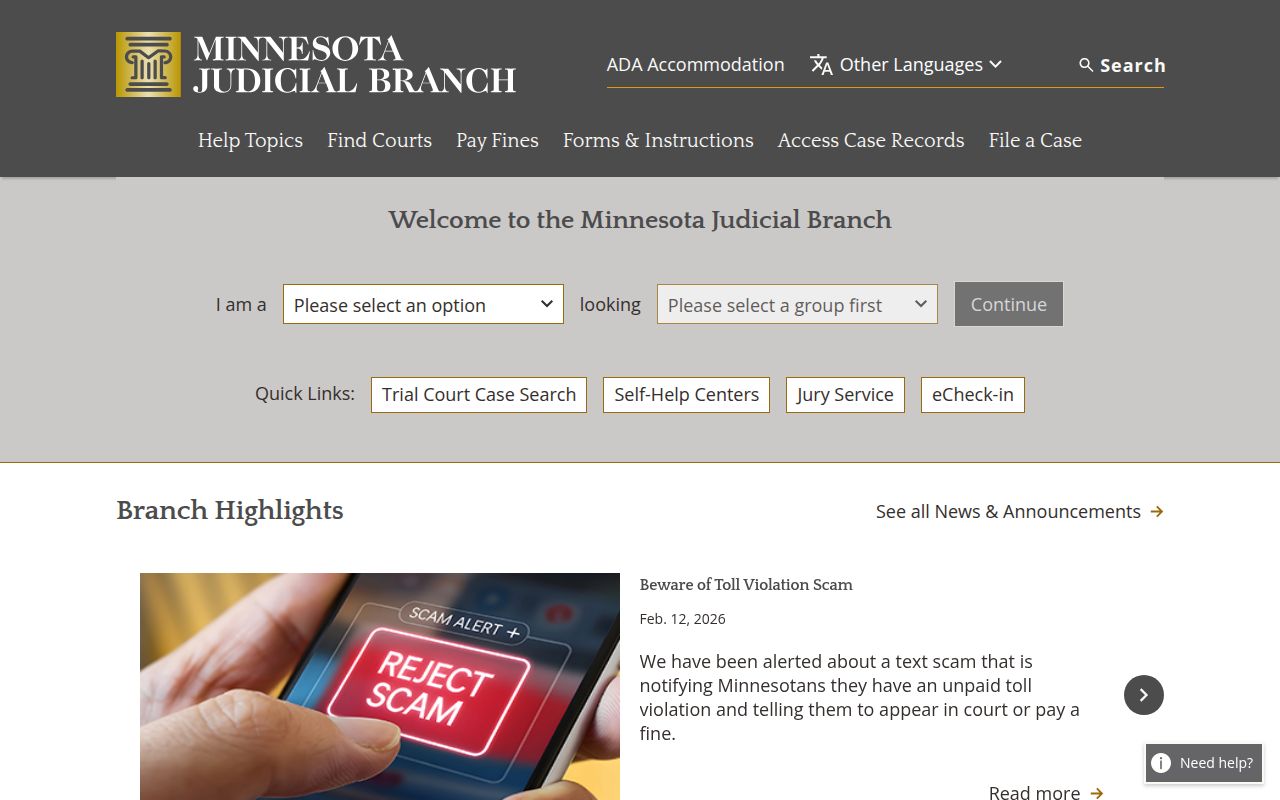
Minnesota's unified court records system gives the public free online access to civil case filings, judgments, and docket entries from every district court in the state.
How to Get Civil Court Records in Minnesota
You have several options for getting civil court records in Minnesota. Online search through MCRO works best for quick lookups and free document downloads. Visiting the courthouse in person gives you full access to the case file, including any documents not posted online. Public access terminals are available at every county courthouse and are free to use. Many courts also accept written requests by mail.
Here are the main ways to access records:
- Online through MCRO at publicaccess.courts.state.mn.us
- Public access terminals at the county courthouse
- In-person request at the Court Administrator's office
- Written mail request to the court administrator with prepayment
For records filed before July 1, 2015, MCRO has limited availability. Older files may show only orders and judgments rather than the full document set. To get everything in the file, contact the court administrator directly at the county where the case was filed. Most counties are open Monday through Friday from 8:00 a.m. to 4:30 p.m. Some service counters stop accepting payments earlier, often at 2:30 p.m. on the last working day of the month. Call ahead before visiting to confirm hours and what identification to bring. The Access Case Records page on the Minnesota Judicial Branch site explains what is and is not available online, along with tips for searching effectively. Certified copies require the court seal and cost more than plain photocopies. Online MCRO downloads are free.
Types of Civil Cases in Minnesota District Courts
Minnesota District Courts handle a wide range of civil matters. Contract disputes arise when one party claims another broke an agreement. Personal injury cases come from accidents or harm caused by another party's conduct. Property disputes cover boundary issues, ownership claims, and damage. Business disputes between companies or partners go to civil court. Debt collection cases produce money judgments that get entered into the court record and are searchable through MCRO's judgment search tool. All these case types generate court records that are open to the public once filed.
Conciliation Court is Minnesota's small claims court. It handles disputes where the dollar amount at issue is $20,000 or less. The rules are simpler, and parties often represent themselves without an attorney. Winning a case does not mean the court collects money for you. The plaintiff must collect any judgment on their own. Details on small claims procedures are at the Conciliation Court help page. The general framework for civil actions in Minnesota is set by Minnesota Statutes Chapter 540, which covers parties, time limits, and how civil actions are started and pursued in court. More information about how to bring or respond to a civil claim is available at the Civil Actions help page on the judicial branch website.
Civil commitment cases, domestic abuse records, and juvenile files are not accessible through MCRO or public terminal searches. These are restricted under court rules regardless of when they were filed.
Fees for Minnesota Civil Court Records
Online access through MCRO is free. You can search for cases and download documents filed after July 1, 2015 without paying anything. When you request copies at the courthouse or by mail, standard fees apply. Plain copies cost $0.25 per page at most courts. Certified copies carry the court seal and cost $16.00 per document plus the per-page copy fee. Exemplified copies, which carry a higher level of legal authentication, cost $28.00 per document. Courts may charge $20 to $30 per hour for extensive searches that require significant staff time to complete.
Payment methods vary by county. Most courts accept cash, check, and money order in person. Many also take credit or debit cards. Mail requests require a check or money order. Do not send cash by mail. Contact the specific court administrator before sending a mail request to confirm current fees and accepted payment forms, as these details can change.
Attorney Access and Electronic Filing
Attorneys admitted in Minnesota can apply for a Minnesota Government Access account. Under Minn. Stat. section 484.94, this account provides access to electronic court records in the Minnesota Court Information System. Government and civil legal services attorneys can view and print documents at no charge. Private attorneys may pay fees set by the judicial branch. Legislation proposed in 2025 through HF2412 and SF2568 aimed to expand this access further for private attorneys by establishing a formal fee structure under amended Section 484.94.
The eFile and eServe system at mncourts.gov/efile handles electronic filing for all Minnesota district courts. It is mandatory for attorneys and government agencies. Self-represented litigants can use it voluntarily. The system accepts Visa, MasterCard, and Discover cards but not American Express. It does not work on smartphones or tablets. As of January 1, 2025, the Minnesota Digital Exhibit System is mandatory statewide for submitting digital evidence in court cases.
Public Access to Court Records in Minnesota
Minnesota court records are presumed open to the public under the Rules of Public Access to Records of the Judicial Branch, adopted by the Minnesota Supreme Court. Anyone can request access during regular court hours. You do not need to state a reason. The rules list specific exceptions. Records that are not public include sealed or expunged records, civil commitment files, juvenile case records, domestic abuse records before service, and documents containing restricted personal identifiers such as Social Security numbers and financial account numbers.
Under Minn. Stat. section 13.90, the judiciary is exempt from the Minnesota Government Data Practices Act. Data access rules that apply to state agencies do not apply to courts. The Supreme Court sets its own access rules for judicial records. Minnesota Statutes are available free online, including civil procedure chapters and court rule references. The Minnesota State Law Library, located at 25 Rev. Dr. Martin Luther King Jr. Blvd. in St. Paul, offers legal research help, public access terminals, and court forms. Call (651) 297-7651 for assistance with legal research.
Note: Documents with restricted identifiers like Social Security numbers must be filed on a separate Confidential Information Form and are not available to the public.
Legal Help for Civil Cases in Minnesota
The Minnesota Judicial Branch runs Self-Help Centers at courthouses across the state. Staff can help you find the right forms, understand the process, and prepare for your court date. They cannot give legal advice or tell you what to do in your case. Find a Self-Help Center near you at mncourts.gov. The Hennepin County Self-Help Center is at the Government Center, location A-20, and serves all Hennepin County residents. Ramsey County offers five free legal clinics each week at the Ramsey County Law Library, covering small claims, housing, and family matters.
The Civil Actions help page on the Minnesota Judicial Branch website walks you through how to start or respond to a civil case step by step. If you need deeper research help, the Minnesota State Law Library provides in-person and phone assistance. Free court forms for civil cases are available through the court website at no cost. For appellate court records, including Supreme Court and Court of Appeals decisions, visit the Supreme Court opinions page.
Browse Minnesota Civil Court Records by County
Each of Minnesota's 87 counties has its own District Court that handles civil cases. Select a county below to find court contact info, address, phone number, and local resources for civil court records in that area.
View All 87 Minnesota Counties
Civil Court Records in Major Minnesota Cities
Minnesota does not have separate municipal courts for civil cases. Residents of major cities file civil cases at the District Court in their county. Select a city below to find the courthouse that serves it and how to access civil court records in that area.